Medical device consulting
From concept to market.
Research and development, regulatory strategy, technology transfer and manufacturing. We support medical device manufacturers from early development through market launch and post-market follow-up.
Discuss your project
Device studiesConcept sketches
Strategic and technical advisory
Where we can help
A start-up with a prototype, a manufacturer facing a process failure and an investor reviewing a technology each have a different decision to make.
Strategy and business development
Assess the clinical need, the market and the technology risks before committing to development, a partnership or an investment.
Device development
Turn the clinical need into design inputs. Compare materials and prototypes, then select the tests that will guide the next decision.
Technical troubleshooting
Reproduce the failure, identify its cause and verify the corrective action on the device or manufacturing process.
Quality and regulatory affairs
Connect design records, risk management and clinical evidence to the technical documentation and post-market follow-up.
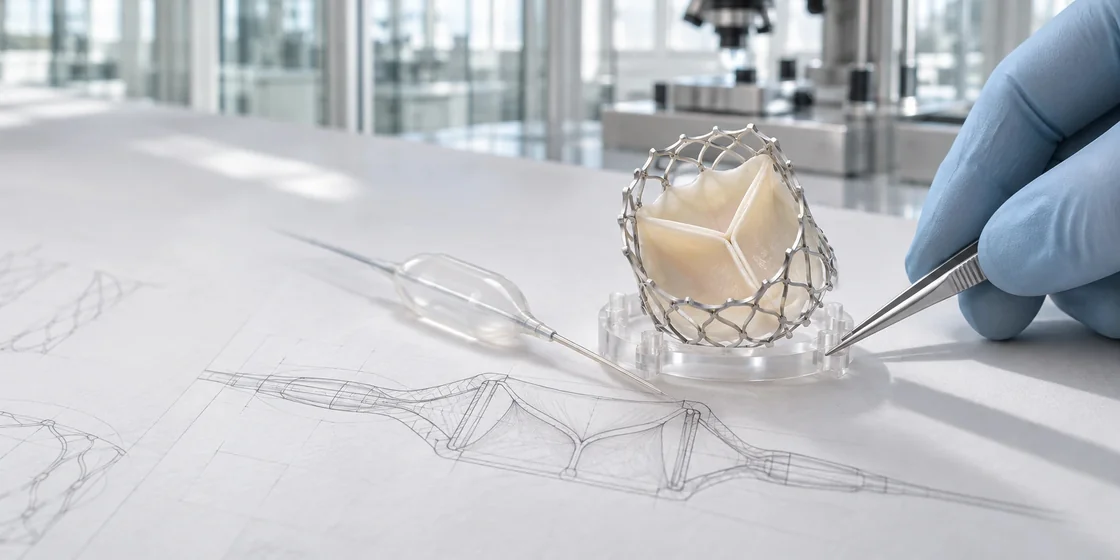
We define the decision, diagnose the problem, agree on a plan and review the results with your team.
Device development
Eight development milestones
Regulatory strategy, risk management and manufacturing planning start when the intended use is defined and continue through post-market monitoring.
Research and clinical need
Define intended use, users, the state of the art and target countries. Establish the product profile and development roadmap.
Feasibility and prototyping
Compare concepts and test critical materials or design features. Use the prototype to establish proof of concept.
Design and development
Translate needs into design inputs. Document the specifications, design decisions and associated risks.
Verification, validation and clinical evidence
Link each requirement to its verification test and the intended use to validation and clinical evidence.
Transfer to manufacturing
Prepare the receiving site, qualify equipment and assess process control on pilot batches. Define release criteria.
Conformity and CE marking
Consolidate the technical documentation and prepare the applicable conformity assessment with the manufacturer.
Launch and market access
Plan the launch country by country. Assess distribution channels and the evidence needed for reimbursement.
Routine production and surveillance
Monitor performance, complaints and vigilance reports. Use field findings to guide design and process changes.
Materials and surface R&D
Surfaces and new alloys
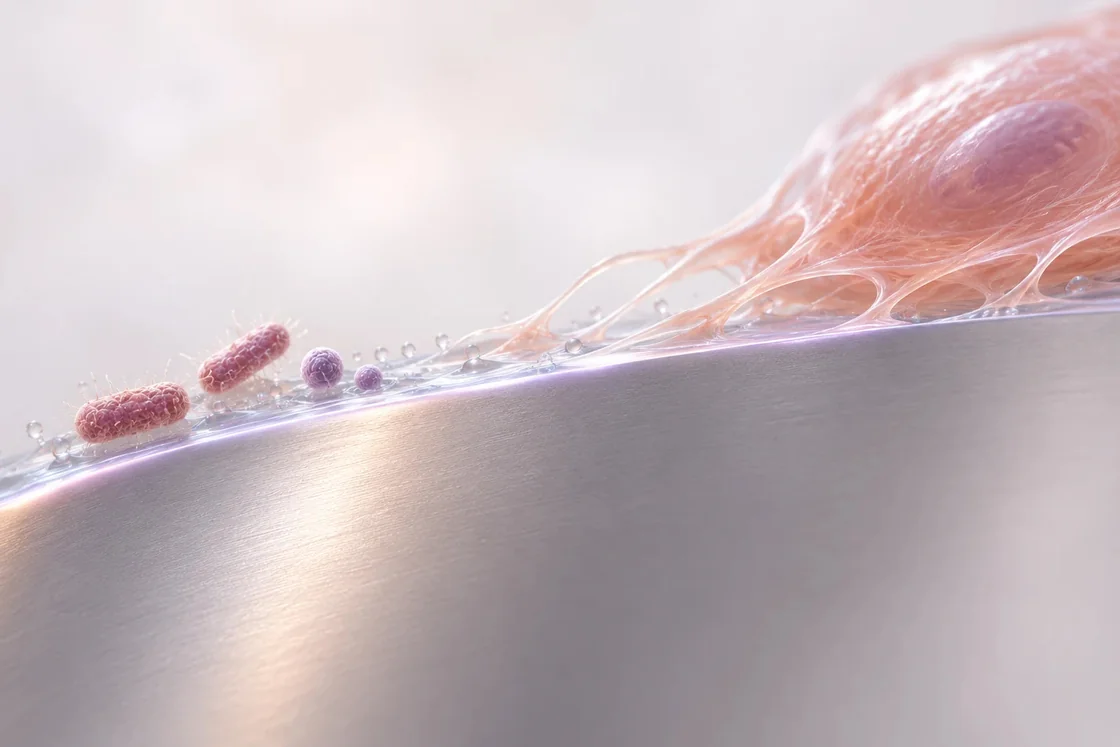
A stent deforms as it opens. A dental connection bears load each time it is assembled. Those conditions guide the choice of alloy, surface and tests.
Select the alloy
Compare composition and microstructure, then assess fatigue and corrosion under conditions relevant to the device.
Engineer the surface
Select a microtexture, plasma activation or a physical vapour deposition (PVD) coating according to the intended surface function.
Qualify the process
Use microscopy, profilometry and adhesion tests to turn surface properties into acceptance criteria, from test coupons to pilot batches.
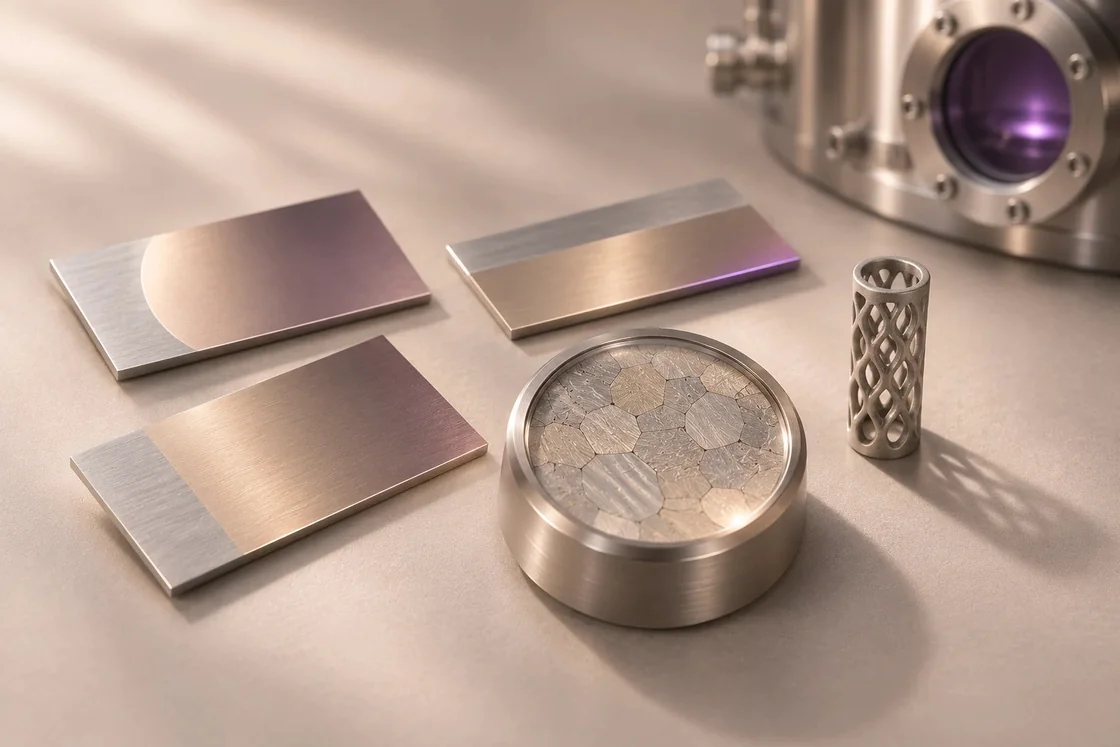
Nitinol for a self-expanding stent and titanium alloys for a dental connection illustrate two different sets of material requirements.
Patents and publications
Research in surface engineering
Selected work by Dr Mustapha Mekki on implant coatings, physical vapour deposition and drug loading in coronary stents.
Radiopaque tantalum adhesion layer · EP 4 065 186
WO 2021/105403 A1 names Johannes Lammer and Mustapha Mekki as inventors and IMC International Medical Contrivances SA as applicant.
Coloured metal coatings · WO 2009/004163 A1
This application describes physical deposition of a metal or alloy to produce a coloured surface. It names Mustapha Mekki as inventor and applicant.
Filling the reservoirs of a stent
Dr Mustapha Mekki, founder of Numiaris MedTech, is the first author of this 2009 study on filling stent microreservoirs with L-arginine and coating them with polyethylene glycol (PEG) and dexamethasone.
Mekki M, Durual S, Scherrer SS, Lammers J, Wiskott HWA. Optimization of Plasma Treatment, Manipulative Variables and Coating Composition for the Controlled Filling and Coating of a Microstructured Reservoir Stent. Journal of Medical Devices, 2009, 3(1), 011005. DOI 10.1115/1.3081394.
Coronary stents
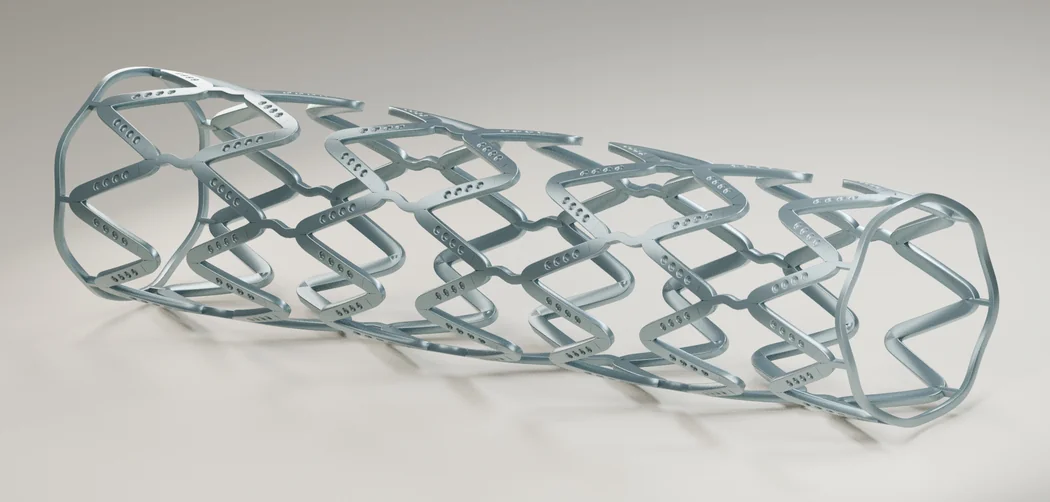
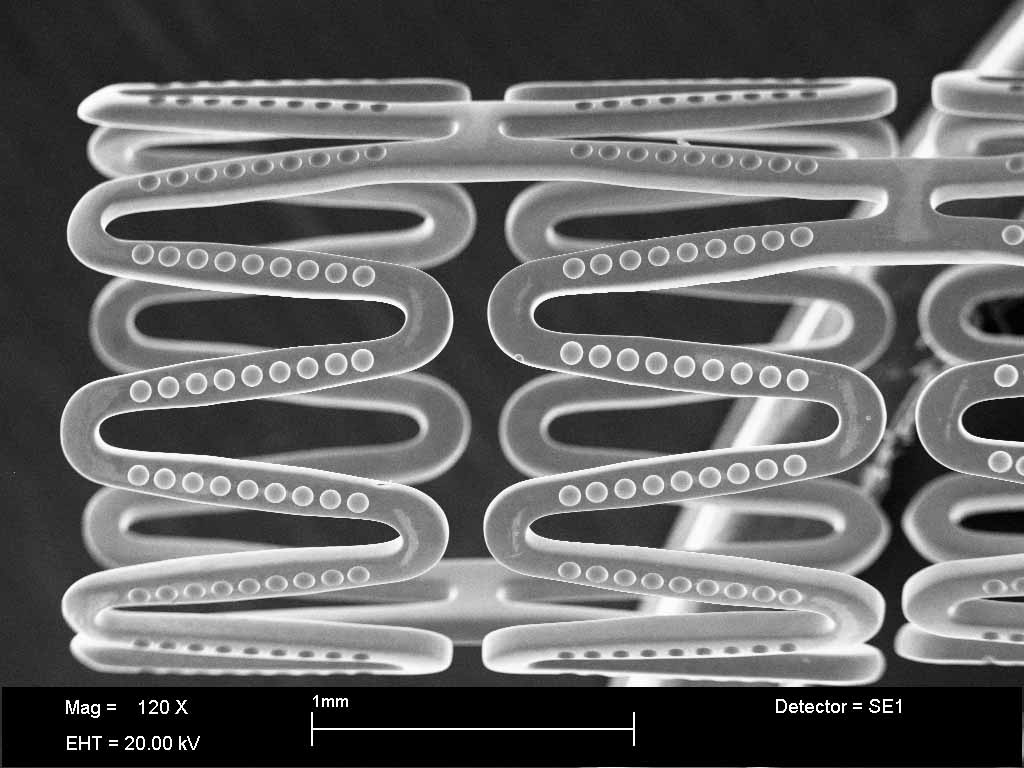
Microreservoirs in the struts
The full stent view places the reservoirs within the lattice. Each blind cavity opens onto the outer face of a straight strut.
Localised microstructuring
The cavity floor retains a continuous layer of metal. The rows end before the curved crowns, and the links have a smooth surface.
Direct drug loading
The concept uses the cavities to hold sirolimus directly in the metal struts, without a polymer carrier.
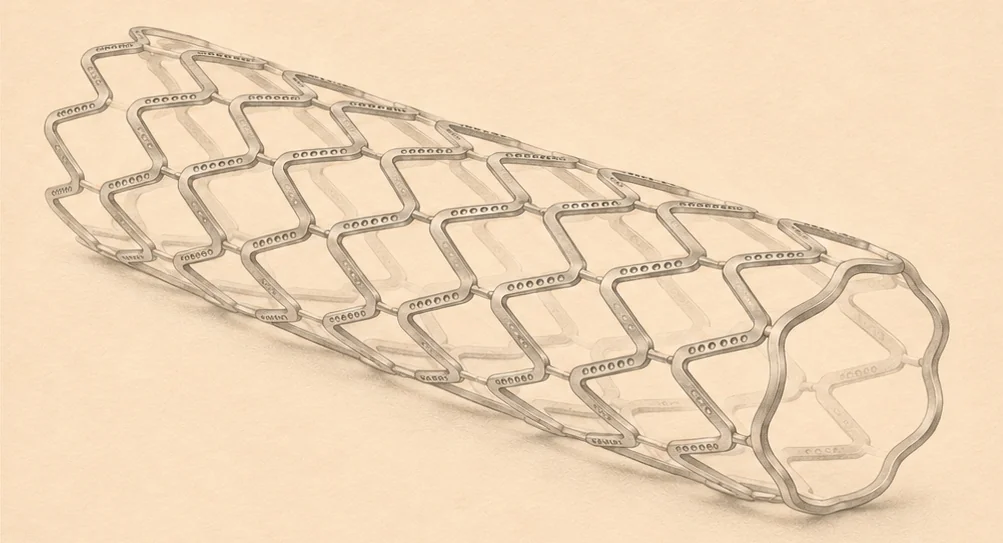
View the stent struts in detail
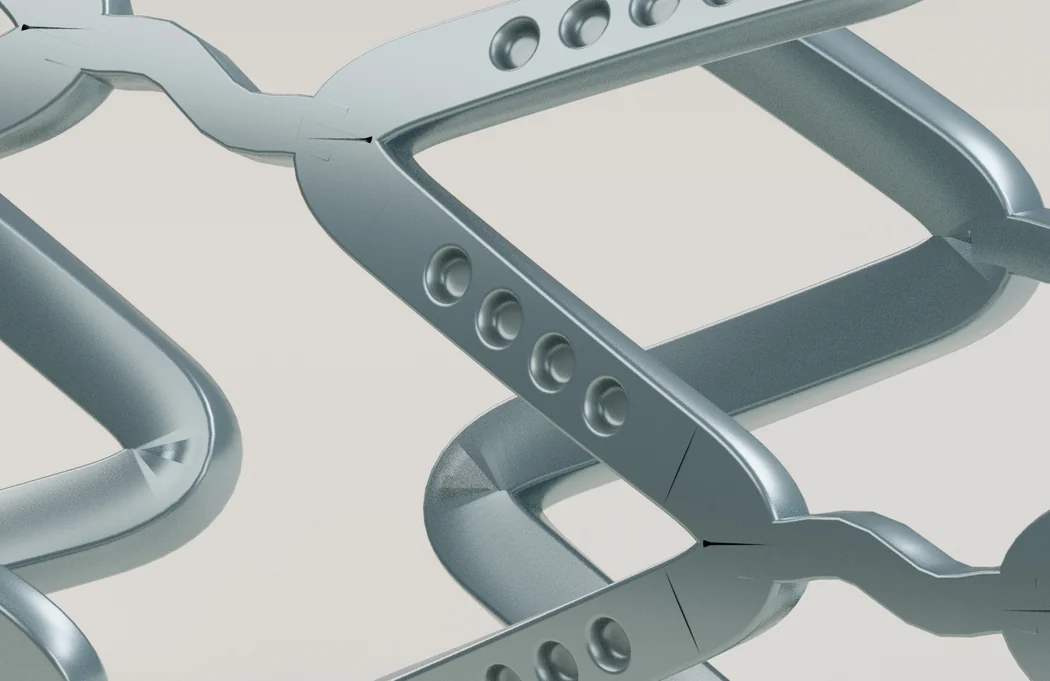
Inside a straight strut


Depth shown schematically.
Quality, clinical and regulatory affairs
Preparing for CE marking
For a class III implant, design records, manufacturing evidence and the clinical evaluation are developed together. We help the manufacturer assemble that evidence.
European regulatory strategy
Define the intended purpose, justify the risk class and prepare the applicable conformity assessment under the EU MDR.
Quality systems and risk
Link the ISO 13485 quality system and ISO 14971 risk management to design decisions, testing and manufacturing changes.
Clinical evidence and GxP
Plan the clinical evaluation and applicable investigations under ISO 14155. Identify GLP requirements for relevant non-clinical safety studies.
Technical documentation and follow-up
Connect the documentation required by Annexes II and III to post-market surveillance, clinical follow-up and vigilance.
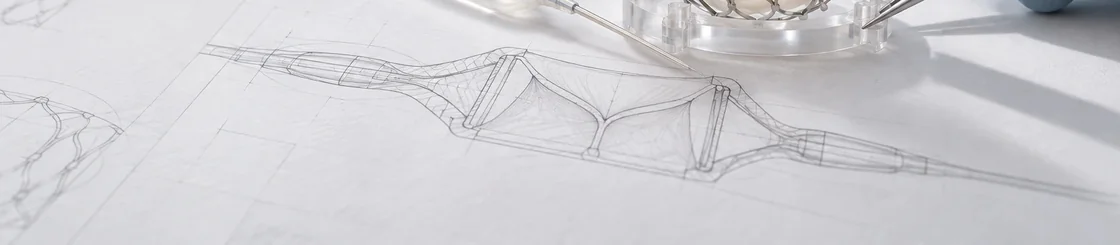
For a series-produced class III device, the notified body assesses conformity. The manufacturer draws up the EU declaration of conformity and affixes the CE marking.
Manufacturing and technology transfer
From the lab to production
Whether the project involves a new manufacturing site or an existing line, we define the transfer with the team that will produce and release the device.
Plan the receiving site
Define capacity, flows of materials and personnel, utilities, workstations and any controlled areas or cleanrooms the device requires.
Transfer the complete process
Transfer drawings, tooling, work instructions and inspection methods. Select suppliers and train the receiving team.
Qualify and scale up
Qualify equipment, validate applicable processes and run pilot batches. Establish packaging, sterilisation where needed and release criteria.
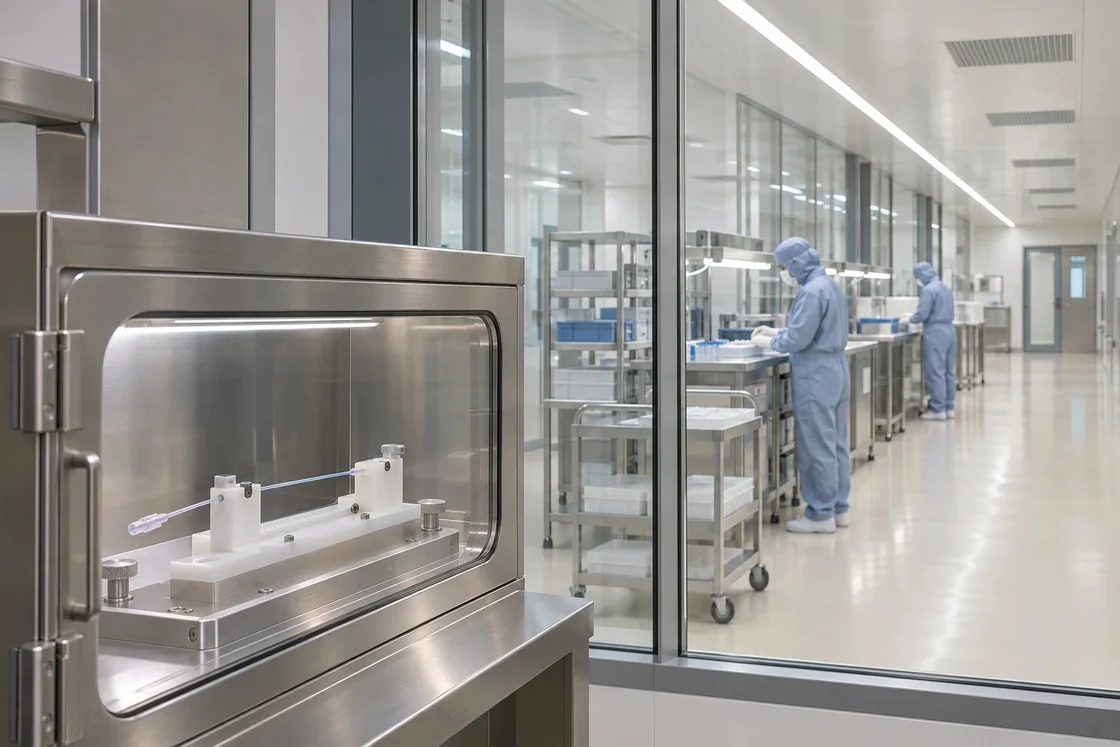
The transfer package records responsibilities, estimated costs, pilot batches and line acceptance criteria.
Device families
Medical devices and implants
From delivery systems to dental connections, the interfaces between components shape the design and the tests each device needs.
Concept illustrations
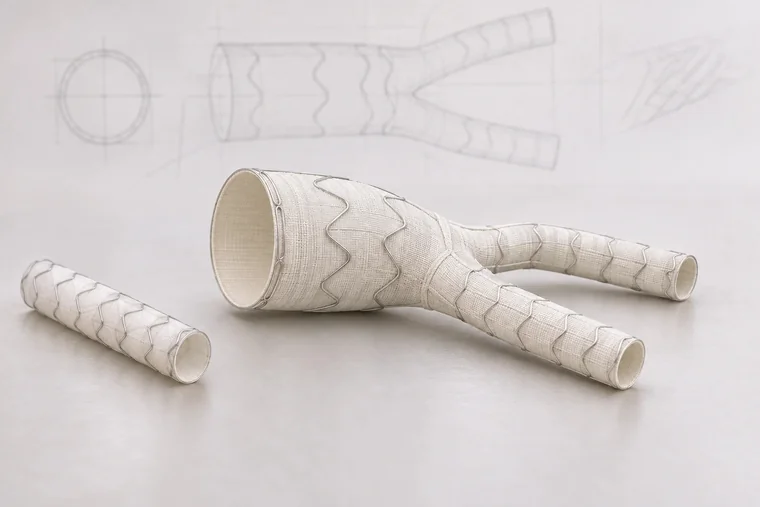
Covered stents and stent grafts
Straight covered stents and bifurcated aortic grafts.
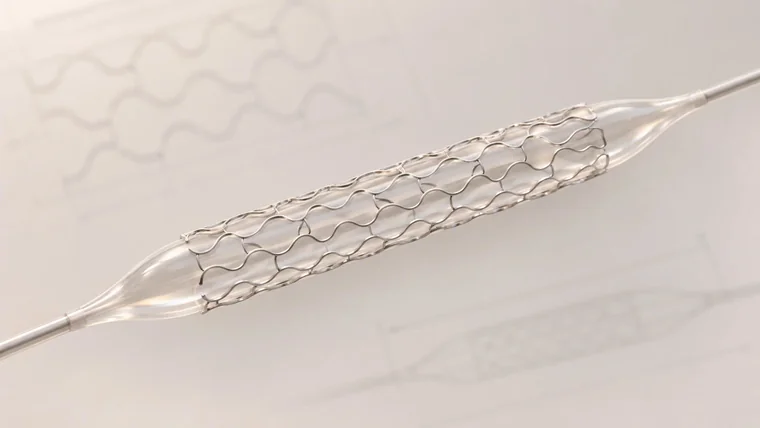
Coronary stents
Stent lattice, crimping and balloon deployment.
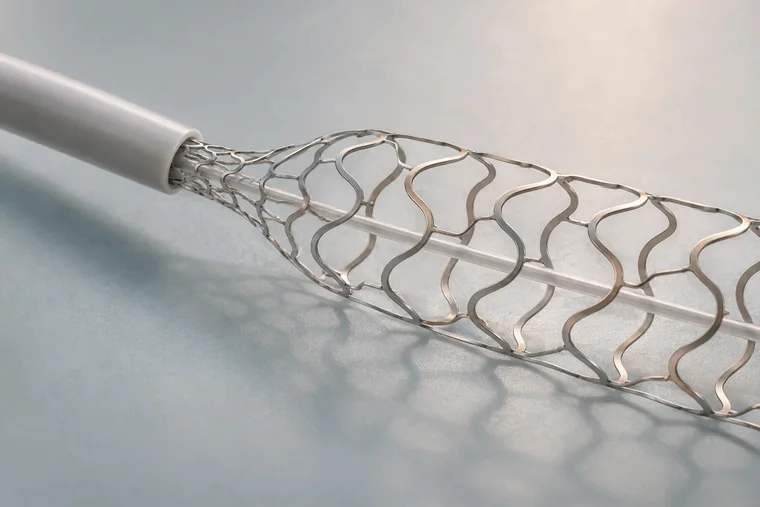
Peripheral stents
Self-expanding nitinol frame and delivery sheath.
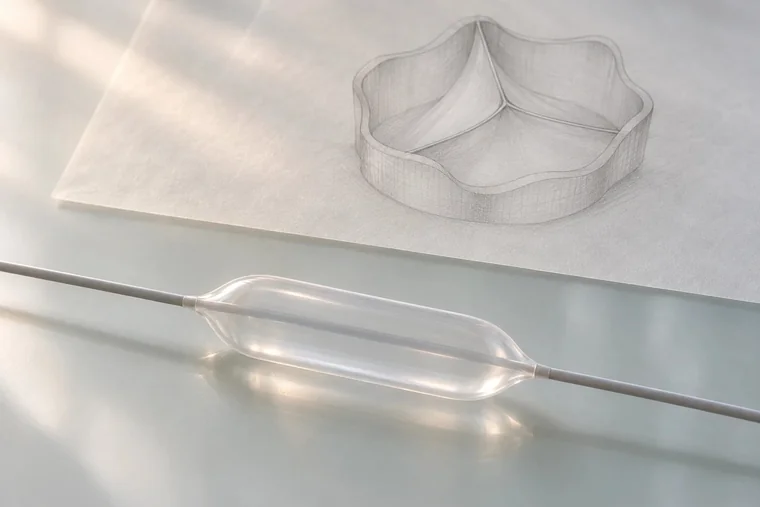
Catheters, balloons and valves
Delivery catheter, angioplasty balloon and valve frame.
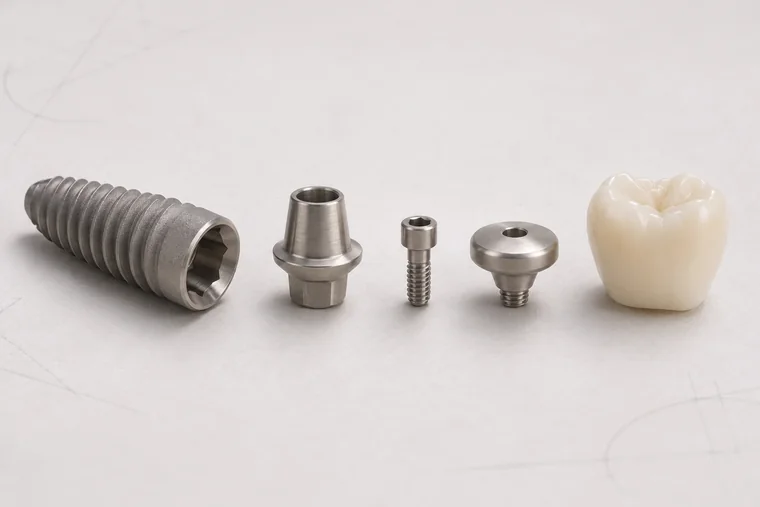
Dental implants and connections
Implant body, connector, fixation screw and restoration.
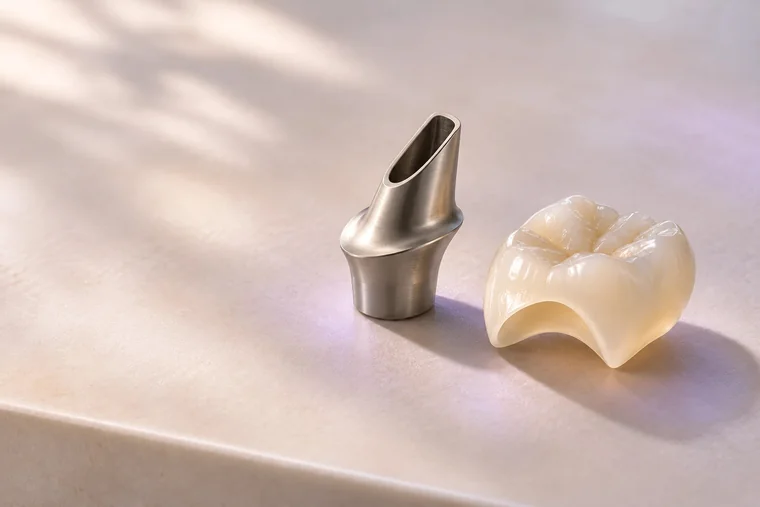
Prosthetic components
Transmucosal abutment and the seating of a ceramic restoration.
Technical guide
The language of device development
The terms below appear in project briefs, test plans, transfer packages and regulatory submissions.
Design and feasibility
Intended purpose, state of the art, proof of concept, computer-aided design (CAD), design inputs and design for manufacture (DFM).
Performance and clinical evidence
Verification and validation (V&V), bench testing, usability, biological evaluation, clinical evaluation and clinical investigations.
Quality and risk
Quality management system (QMS), ISO 13485, risk management (ISO 14971), change control and corrective and preventive action (CAPA).
Manufacturing and transfer
Equipment and process qualification (IQ/OQ/PQ), pilot lots, process validation, packaging, sterilisation where applicable, and release.
Access to market
EU MDR, CE marking, unique device identification (UDI), pricing, procurement and reimbursement by country.
Post-market follow-up
Post-market surveillance (PMS), post-market clinical follow-up (PMCF), vigilance and periodic safety update reports (PSUR), where applicable.
Business development
Partnerships and market access
A manufacturer bringing production in-house and an investor assessing a device need different evidence. We build the case around the decision they face.
Market entry and reimbursement
Identify who prescribes, buys and pays. Test pricing and reimbursement assumptions to build a launch plan for each market.
Industrial partnerships
Compare local manufacture, OEM supply, licensing and distribution. Define the partner’s capabilities, investment, technology rights and quality responsibilities.
Due diligence and funding
Assess device maturity, evidence gaps and industrial risks. Link funding needs to the next technical and commercial milestones.
A complete technology transfer
Cost the equipment, tooling, training and pilot lots. Agree with the receiving team how it will demonstrate the line meets acceptance criteria.
From Geneva, we work with teams in Switzerland and abroad. We agree on access to project information and on which deliverables can be shared.
Contact
Discuss your project
For a medical device development programme, regulatory strategy or manufacturing transfer, contact Dr Mustapha Mekki in Geneva.
Registered office
Numiaris MedTech Sàrl
c/o ExpertFid & Audit SACours des Bastions 13
1205 Geneva, Switzerland
Swiss enterprise ID CHE-208.158.574